
Tattoo Removal with Pico Lasers
Picosecond laser technology transformed tattoo removal by shifting the photothermal fragmentation threshold to pure photomechanical photoacoustic disruption. Explore the biophysics of ink chromophore clearance, wavelength matching, and pulse duration optimization across diverse Fitzpatrick skin types.
Standardized assessment protocol for tattoo clearance rates, photothermal sparing, and Fitzpatrick-adjusted dosimetry.
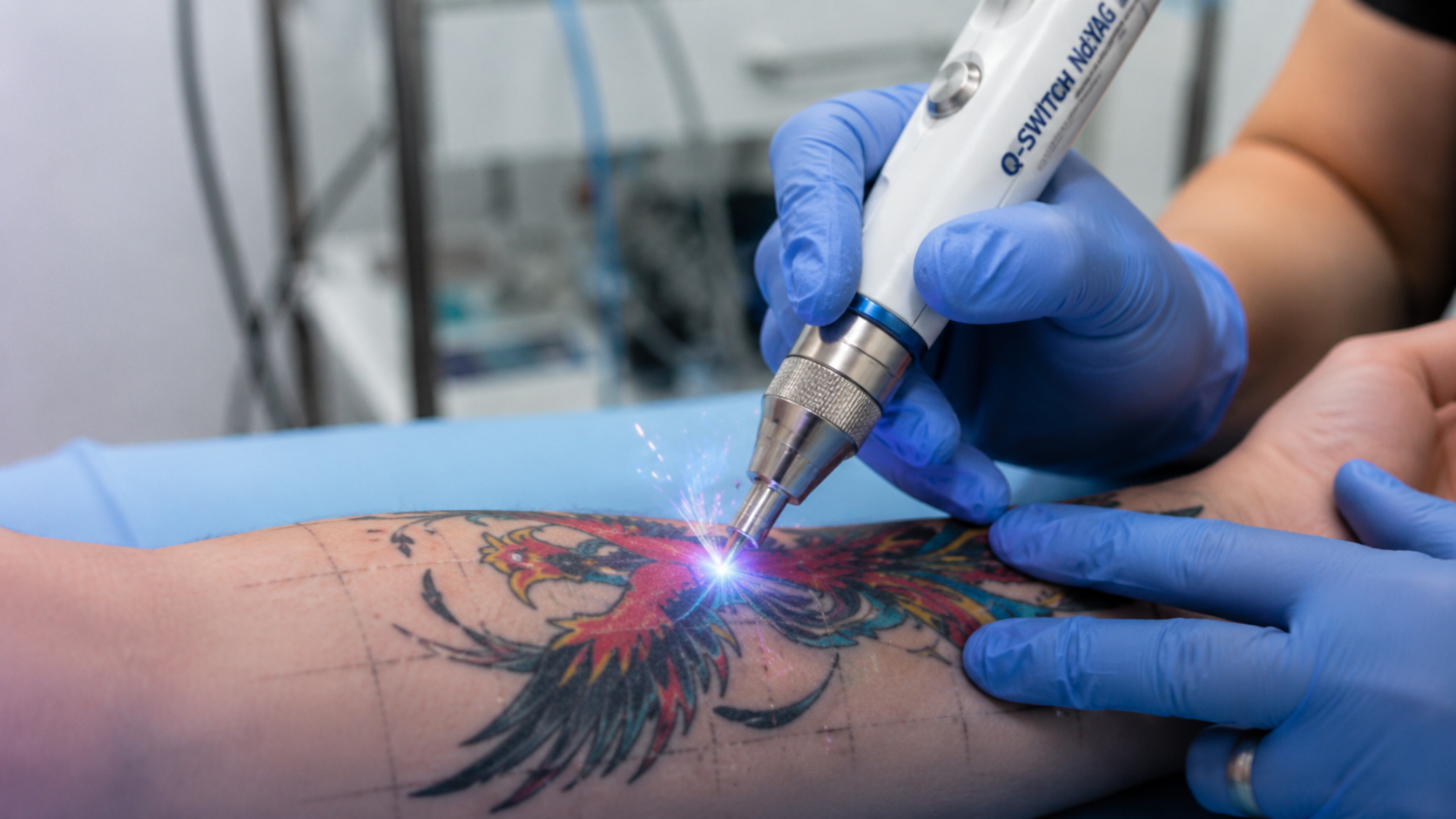
Immediate tissue response: Intracellular micro-cavitation and epidermal whitening (frosting) caused by rapid acoustic steam bubble nucleation, confirming selective photomechanical targeting without non-specific thermal conduction.
Photoacoustic Shockwave
Stress confinement fractures pigment granules purely through pressure gradient waves exceeding tensile limits.
Exogenous Pigment Granules
Dermal ink aggregates typically sized 10–100nm, requiring picosecond pulses to prevent peripheral heat dissipation.
4–8 Sessions
Over 50% fewer visits compared to legacy Q-Switched nanosecond lasers (average 10–15 sessions required).
Ink-Color Chromophore & Wavelength Matching
Different ink pigments exhibit distinct absorption spectra. Optimal clearance requires matching laser wavelengths to the specific absorption bands of each pigment color family.
Broad absorption spectrum; deepest penetration with minimal melanin competition.
Clears fastest with 1064nm, lowest risk of epidermal hyperpigmentation in darker phototypes.
Strong oxyhemoglobin and melanin absorption band; highly effective for bright warm pigments.
High affinity for red pigments, requires calibrated fluences to protect epidermal melanocytes.
Specialized window where green and light blue pigments absorb intensely without competing with 1064nm.
Historically recalcitrant under nanosecond lasers; picosecond 755nm/730nm yields rapid clearance.
Synchronous multi-spectrum absorption across superficial, mid, and deep dermal layers.
Multi-color professional tattoos require multi-modal platforms with handpiece versatility or dye handpieces to prevent incomplete treatment.
Wavelength Selection & Penetration Depth
Laser photon penetrance in human dermis is determined by competing scatter and absorption coefficients. Deeper reticular dermal ink demands longer wavelengths to bypass epidermal scattering.
Pulse Duration & Acoustic Stress Confinement
Acoustic stress confinement occurs when the laser pulse duration is shorter than the time it takes for mechanical sound waves to traverse the ink particle. Picosecond delivery confines energy mechanically before heat conducts outward.
Photothermal
Cracks ink into coarse "pebbles". Slower phagocytosis and increased collateral thermal injury to adjacent collagen.
Photomechanical
Pulverizes ink into microscopic "dust" particles readily engulfed and evacuated by systemic lymphatic macrophages.
Skin Phototype & PIH Risk Protocol
Preserving background epidermal melanin is paramount when treating tattoos. Wavelength choice must adapt to the patient's baseline Fitzpatrick phototype to prevent dyschromia.
Type I & II
Safe across 1064nm, 755nm, and 532nm. Very low risk of post-inflammatory hyperpigmentation (PIH). Full energy titration can proceed aggressively.
Type III & IV
Moderate PIH risk. 1064nm preferred baseline; 755nm and 532nm require conservative fluences and mandatory test spots prior to full treatment passes.
Type V & VI
High risk of hypopigmentation and scarring. 1064nm Nd:YAG is mandatory standard of care due to negligible epidermal melanin absorption. Avoid 532nm.
Pico Lasers Commonly Considered for Tattoo Removal
Leading clinical systems evaluated for tattoo removal versatility, wavelength array, and peak power.
Candela PicoWay
Picosecond Nd:YAG PlatformUltra-short pulse duration, superb multicolor clearance including stubborn greens and blues via dedicated 730nm/785nm handpieces.
Cynosure PicoSure Pro
Alexandrite TechnologyUnrivaled clearance for greens, blues, and black inks with extensive FDA clearance across multiple tattoo indications.
Quanta Discovery Pico
Dual-Cavity SystemMassive acoustic impact on deep recalcitrant inks; true ruby 694nm laser for intense green and blue pigments.
Aesthetika PicoTech
Multi-Handpiece WorkstationBroad multi-color dye handpiece coverage, robust 2-year warranty support, balanced capital investment for growing clinics.
Not Sure Which Platform Fits Your Practice?
Use our interactive diagnostic selector to match your patient volume, budget, and treatment focus with verified clinical platforms.