
What Is Pulse Duration?
In laser dermatology and laser aesthetic physics, pulse duration (often denoted as temporal pulse width, $\tau_p$) defines the exact duration in time over which optical radiation is emitted in a single laser pulse. While energy determines the total quantity of photons delivered (in joules or millijoules), pulse duration defines the speed and temporal concentration of that energy delivery.
Historical tattoo removal and pigmented lesion systems utilized Q-switched nanosecond technology, operating in the domain of billionths of a second ($1\text{ ns} = 10^{-9}\text{ s}$). Modern ultra-short clinical devices emit pulses in the picosecond regime, operating at trillionths of a second ($1\text{ ps} = 10^{-12}\text{ s}$). Shortening this temporal window by a factor of 10 to 100 transforms the biological reaction in human tissue from heat-driven boiling to cold mechanical pulverization.
In laser dermatology, pulse duration dictates whether energy creates non-thermal acoustic stress confinement or thermal diffusion into surrounding healthy tissue. Shortening temporal width elevates peak power without necessitating elevated overall energy.
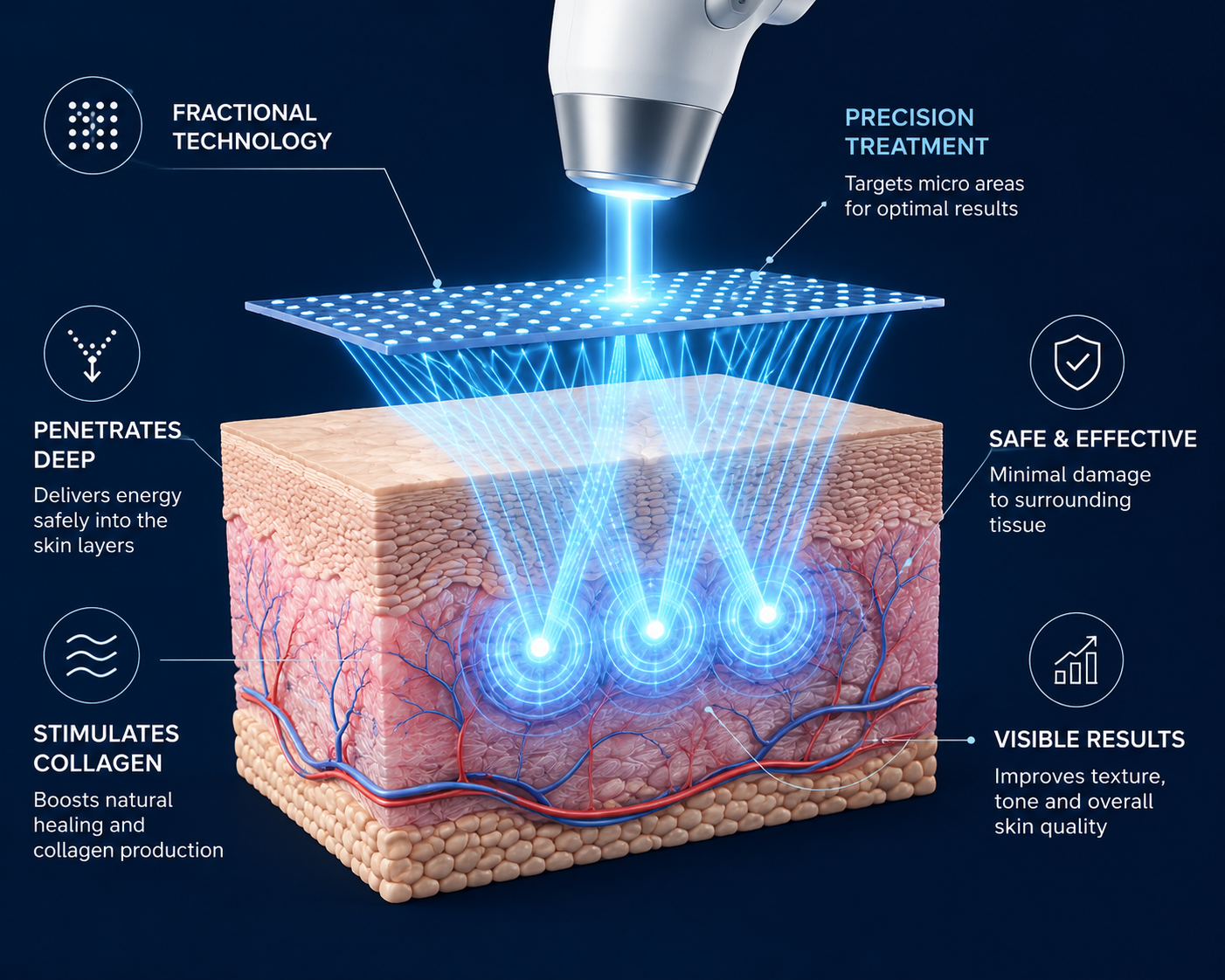
Fig 1.0: Laser-Induced Optical Breakdown (LIOB) and localized acoustic micro-fragmentation driven by ultra-short pulse durations traversing epidermal barriers into target dermal chromophores.
Picosecond vs. Nanosecond: The Temporal Scale
Understanding temporal scale requires contextualizing orders of magnitude. Light travels approximately 300,000 kilometers per second. In one nanosecond ($10^{-9}\text{ s}$), light travels approximately 30 centimeters (roughly one foot). In 300 picoseconds ($300 \times 10^{-12}\text{ s}$), light travels merely 9 centimeters. By compressing the emission cycle, instantaneous optical irradiance spikes exponentially.
Temporal Continuum
Comparative pulse widths of FDA-cleared aesthetic platforms
Bulk thermal heating, larger fragmentation
755nm Alexandrite pulse standard
Acoustic stress threshold for carbon ink
Why Shorter Pulses Matter: Acoustic Stress Confinement
The fundamental physics dividing picosecond technology from legacy nanosecond systems is Stress Confinement. While classic photothermolysis relies on Thermal Relaxation Time ($t_r$), modern ultrashort lasers rely on Acoustic Stress Relaxation Time ($t_c$).
t_c = d / v_s
Where d is the optical diameter of the target chromophore (e.g., carbon particles 40–100nm or melanosomes ~1μm), and v_s is the speed of sound in tissue (~1,500 m/s).
When pulse duration is shorter than the time required for a mechanical shockwave to traverse the target chromophore, stress waves accumulate into massive tensile pressures that shatter pigment without conductive heat buildup. If the laser pulse exceeds this duration, acoustic stress dissipates into the extracellular matrix as radiant heat, provoking collateral inflammation, blister formation, and post-inflammatory hyperpigmentation (PIH).
Shorter pulse durations generally produce a stronger photoacoustic shockwave, pulverizing pigment into microscopic "dust" rather than coarse "pebbles", accelerating macrophage phagocytosis and lymphatic clearance by up to 50%.
Photoacoustic vs. Photothermal Effect
A direct structural and clinical comparison between temporal delivery modes.
Longer Pulses / Heat Dominant
- thermostat Mechanism: Target chromophore heats up past boiling point to fracture thermally.
- grain Particle Breakdown: Coarse "pebble-like" debris. Slower macrophage clearing.
- warning Tissue Impact: High peripheral heat conduction. Elevated blistering and PIH danger in Fitzpatrick IV–VI.
- schedule Clinical Downtime: 7–14 days recovery period with crusting.
Ultra-Short / Mechanical Dominant
- cyclone Mechanism: Instant stress gradient exceeding tensile strength threshold.
- auto_awesome Particle Breakdown: Ultra-fine "dust" matrix. Phagocytosis accelerated by >50%.
- shield Tissue Impact: Negligible thermal diffusion, intact cellular architecture, safe across skin of color.
- check_circle Clinical Downtime: 24–48 hours transient erythema with rapid re-epithelialization.
Download the 2026 Pico Laser Buyer's Guide & Optical Whitepaper
Access comprehensive teardowns of bench-tested pulse widths, optical power degradation logs, and multi-wavelength clinical ROI models.
Pulse Duration Across the 8 Leading Platforms
Objective technical metrics collected from manufacturer OEM specifications, FDA clearances, and independent optical oscilloscope bench tests.
| Platform Name |
Pulse Duration (ps)
|
Native Wavelengths | Peak Power / Notes | Primary Clinical Focus |
|---|---|---|---|---|
| Cynosure PicoSure Pro | 750 ps | 755 nm Alexandrite | 0.36 GW (Gentle acoustic) | Melasma, benign epidermal lesions |
| Candela PicoWay | 250 – 450 ps | 1064, 785, 730, 532 nm | Up to 0.9 GW | Multicolor tattoos, deep dermal pigment |
| Quanta Discovery Pico | 450 ps | 1064, 532, 694 nm Ruby | Up to 1.8 GW (Highest peak) | Dense inks, recalcitrant carbon lesions |
| Cutera enlighten | 660 / 750 ps dual | 1064, 532, 670 nm | Includes 2ns Q-switch mode | Tattoo removal, skin revitalization |
| Aesthetika PicoTech | 350 ps | 1064, 532, 755, 585, 650 nm | Optically stable multi-dye | Full spectrum ink, vascular melasma |
| Asclepion PicoStar | 300 – 400 ps | 1064, 532 nm | Compact articulated arm | Fast pulse rep rate, carbon peels |
| Rohrer PicoLazer | 450 ps | 1064, 532, 585, 650 nm | Value segment champion | Mid-tier aesthetic practice entry |
| Lumenis PiQo4 | 600 – 800 ps | 1064, 532, 585, 650 nm | Dual nano/pico combination | Large spot size deep penetration |
Key Clinical Takeaways & Practice Summary
Wavelength targets; Pulse duration fractures
Wavelength selection dictates photon absorption by specific chromophore colors (melanin, carbon, azo dyes), while pulse duration dictates whether that absorbed energy shatters mechanically or boils surrounding tissue.
Sub-500ps threshold produces superior acoustic stress
Pulses below 500 ps deliver substantially higher acoustic stress for stubborn carbon and recalcitrant ink colors, breaking them into smaller dust-sized fragments compared to 750ps+ systems.
Maximized epidermal safety in Fitzpatrick IV–VI
Shorter pulses preserve epidermal integrity in skin of color, radically reducing thermal diffusion into baseline epidermal melanin and minimizing post-inflammatory complications.
When evaluating devices, match pulse duration to your primary case mix: sub-500ps platforms excel in rapid tattoo clearance and epidermal pigmentation with minimal downtime, while 750ps Alexandrite systems hold strong clinical literature for skin revitalisation and melasma toning.
Peer-Reviewed Citations & Scientific References
- Brauer, J. A., et al. (2012). Use of a Picosecond Pulse-Duration Laser with Specialized Optic for Treatment of Facial Acne Scarring. JAMA Dermatology, 151(3), 278-284.
- Ross, V., et al. (2015). Comparison of Picosecond and Nanosecond Lasers in the Removal of Tattoos in an Animal Model. Lasers in Surgery and Medicine, 47(4), 336-342.
- Freedman, J. R., et al. (2016). Laser-Induced Optical Breakdown and Picosecond Lasers for Skin Rejuvenation. Journal of the American Academy of Dermatology, 74(5), AB270.
- Tanghetti, E. A. (2016). The Histology of Skin Treated with a Picosecond Alexandrite Laser and a Fractional Focus Lens Array. Lasers in Surgery and Medicine, 48(7), 646-652.